Star Market
***
No windows, no clocks, bright white fluorescent lights, repetitive sounds from machines, confusing layouts, a lot of sensory input.
Whenever I’m there, I feel like I am outside of normal time.
Doesn’t matter if it’s early in the morning, or late at night: it’s always the same.
I get excited, I get distracted, I have a good time.
When I leave, I am tired, overstimulated, and financially worth less.
It is not a casino, it is not a metro station, it is not a hospital.
It is Star Market.
The Star Market is one of those places that I visit often but think about it rarely. It is a liminal space, a passage to my favorite dish, or laundry detergent. Unfortunately, I started to think about this place more and more. It is unfortunate because thinking of Star Market might be one of the few things that is more unsettling than Star Market itself.
Moreover, all of these thoughts lead me to the same sickening question, a question that is deeply political and personal to me.
Do I love it, or do I hate it?
The question is political because the answer represents the microeconomic stance that I take. I am never afraid to say that I left Questrom School of Business after only one semester not because I suddenly discovered a grand passion for Mechanical Engineering, but because I found the content of some of the classes I took to be absolutely comical. In one of those classes, I was carefully taught two concepts that supposedly make up one of the most important frameworks of corporate business ethics: Corporate Social Responsibility and Creating Shared Value.
Corporate Social Responsibility says businesses should care about society, the environment, and the communities around them. Creating Shared Value says they can do this while also making money. On paper, both sound noble. In practice, the fact that we need names for these ideas feels like evidence of a failed system.
If a company needs meetings, reports, strategies, and branding campaigns to explain why it should not destroy the community around it, then something has already gone wrong. In the neighborhood where I grew up, no shop owner needed a corporate framework to understand these things. No shop was profitable enough to throw away every piece of reusable plastic or cardboard. No one needed a seminar to understand that if they littered, discriminated, abused their workers, or treated people badly, they would lose their customers. More than that, most shop owners lived a block or two away from their stores. Their employees were often relatives, or people who had worked there for so long that they had practically become relatives. Most of the customers were not abstract market segments. They were neighbors, friends, and familiar faces.
In that kind of neighborhood, “social value” does not need to be connected back to profit through a theory. It is already built into daily life. It is natural, intuitive, and unavoidable.
When I was in Questrom, it seemed like I was the only one that perceived things this way. So, I left. I criticized the Star Market, hated it, and voiced my concerns about it being almost a monopoly in the neighborhood. Simpler times.
The question is personal because the answer represents both my past and my present. I remember my mom taking me to a small grocery store every week when I was around five years old. It was the kind of grocery store where almost half of the products for sale were not inside, but outside on the sidewalk. There was always a man with a hose, watering the vegetables and fruits displayed out front, which I later realized was his way of keeping them fresh for longer.
Inside, the store was dark. The products were cluttered together. The aisles were not drawn with a ruler; I doubt even the architect who designed the building used one. The layout was irregular, full of twists, turns, corners, and dead ends. It was not cleanly organized, at least not in the way a modern supermarket is supposed to be organized.
And yet, now that I am almost twenty-two, even though I have not stepped into that store in the past decade, I am sure I could still find everything I need there easily.
It took me almost a year to figure out where the tomato purée was in Star Market.
But eventually, I did. Now, not only can I find it, but I can also recall the exact aisle it is in, what products it is next to, and how many different brands and types of tomato purée are available. I know the logic of the place now. I know where the eggs are, where the pasta is, where the overpriced berries are, where the cheap canned beans are, and which checkout line moves the fastest. Slowly, against my own resistance, Star Market became legible to me.
The question is sickening because, on my recent trip to New York City, I secretly wished for the comfort of my latte and BLAT sandwich from Tatte instead of walking into a random family-owned coffee shop in the city. I know, deep down, that I keep looking for the comfort that Star Market offers me. I know, even though I am afraid to say it out loud, that every summer when I go back home, part of me wishes there were a Star Market there too. A place where I can find everything. A place where it is always the same. A place where I know I will have the same experience every time I walk in, no matter what.
Maybe, just maybe, if there were no Star Market on Commonwealth Avenue, and if the idea of chain markets with the same bright lighting and ruler-drawn aisles did not exist, my life here would be worse overall. Maybe this standardization, as disturbing as it sometimes feels, is also what makes life easier. It saves me from uncertainty. It gives me a system I can learn. It gives me the comfort of knowing where things are, how much they will cost, and what kind of experience I will have before I even enter the building.
But this comfort comes from scale. It is only possible because of chains, logistics, branding, and billion-dollar corporations. The same system that makes Star Market feel sterile, artificial, and politically suspicious is also the system that makes it reliable. And in that case, maybe this is where concepts like Corporate Social Responsibility and Creating Shared Value begin to make sense. Maybe, in a world built around corporations, we need corporate language to force them to behave like neighbors. Maybe, also, I should have stayed in business school.
Star Market is an interesting place. It definitely lacks personality. It is nothing and everything at the same time, and this is the exact reason why I hate it but cannot help loving it too. It is a liminal place, both in its physical and metaphysical existence, and because of that, it is probably not very good for my mental health to think about it too much. Star Market is many things, but above all, it is one of those places that throws my hypocrisy back in my face: I pretend I am above the system while being a perfect part of it.
Do I love it or hate it? Yes.
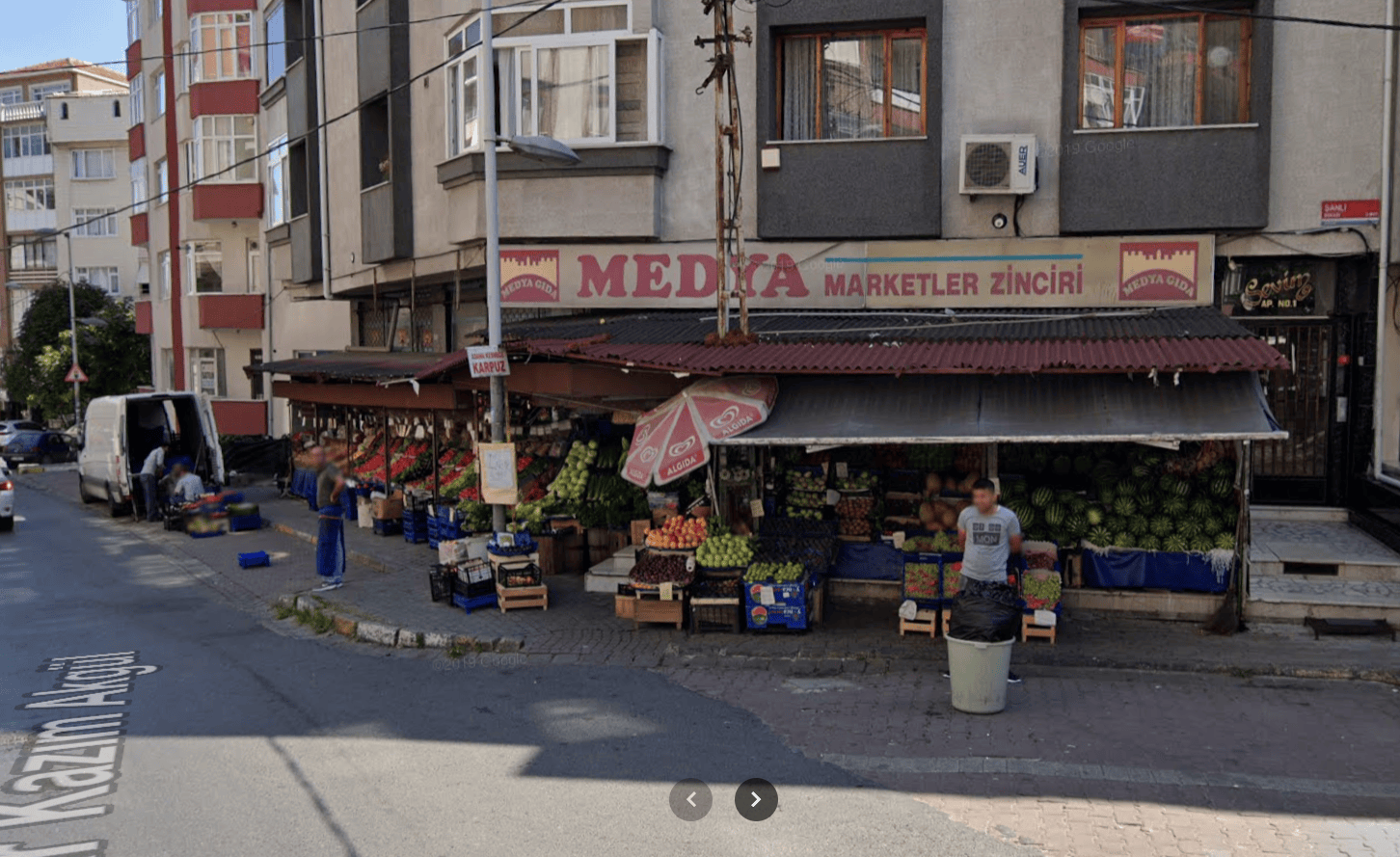
The grocery store my mom used to take me to in Istanbul, Turkey. I lived the first 11 years of my life just 300 meters away from this store.
18 Muhtar Kazım Akgül Cd., Denizköşkler, Avcılar, Istanbul, Turkey Image accessed through Google Maps Street View, September 2019.